
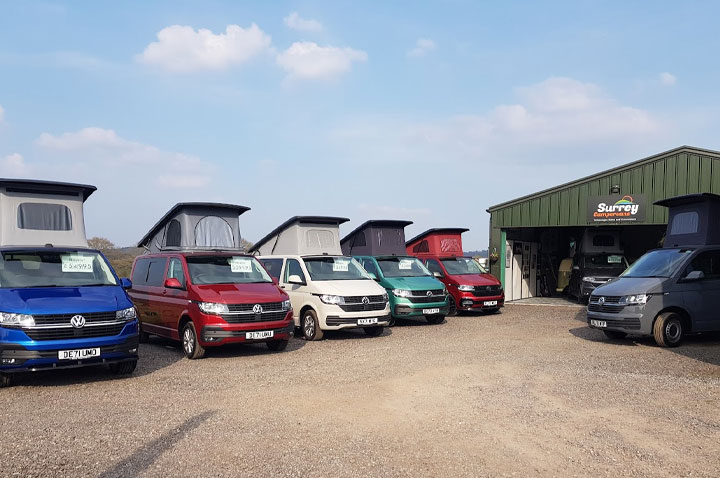
Viewing a used campervan is different from viewing a car. You’re not just buying a vehicle — you’re buying a living space. Here’s what to check before you commit.
The Base Vehicle First
It sounds obvious, but many buyers get so distracted by the conversion that they forget to properly check the van itself.
Check:
- Full service history — gaps in servicing are a red flag, especially on higher-mileage examples
- Cam belt / timing chain service record — ask when it was last done
- Any warning lights on the dashboard
- Tyre condition and age (look for the 4-digit date code on the sidewall — tyres over 6 years old should be replaced regardless of tread depth)
- Any accident damage — check panel gaps are even, look for paint colour mismatches
- HPI check — confirms no outstanding finance, not written off, correct mileage
On a test drive:
- No smoke from the exhaust on start-up
- Gears change smoothly (especially important on DSG automatics)
- No pulling to one side under braking
- Air conditioning works properly
The Conversion and Living Area
Kitchen:
- Does the hob light on all burners?
- Any corrosion around the sink area?
- Does the fridge cool properly? (Run it for 30 minutes if possible)
- Are cupboard doors and drawers fitting and closing properly?
Electrics:
- Ask how old the leisure battery is — one over 4–5 years may need replacing (budget £100–£250)
- Solar panel — does it show a charge reading?
- Does the 240v hook-up socket work?
- All internal lights, USB points, and 12v sockets functioning
Gas:
- Ask for the gas safety certificate — it should be current (within 12 months)
- Check the gas locker — no smell, no corrosion on pipes
- Does the hob and any gas heater ignite cleanly?
Damp — the big one:
- Press firmly on the walls, ceiling, and floor around windows and roof edges — soft or spongy areas indicate damp
- Look for tide marks, staining, or any musty smell
- Check around the pop-top seal if the van has one
Pop-top roof (if applicable):
- Does it open and close smoothly?
- Inspect the seal all the way around — any cracking or lifting will let water in
- Check the fabric for tears or mould
Payload — The Issue Many Buyers Don’t Know About
Every van has a maximum permitted weight (Gross Vehicle Weight or GVW). A campervan conversion adds significant weight, and if the loaded van exceeds its GVW it is technically illegal to drive and will be uninsured in an accident.
Ask the dealer for the conversion weight certificate or chassis plate, and check what payload remains for passengers, luggage, and water. A reputable dealer should be able to answer this clearly.
The Bottom Line
A well-maintained campervan from a reputable dealer will have nothing to hide. If a seller is evasive about service history, won’t let you inspect the van properly, or can’t answer basic questions about the conversion — walk away.
At Surrey Campervans, every van we sell comes with a full history check, pre-sale inspection, and honest answers to every question. Call us on 01483 323 901 to arrange a viewing.